08 THE BIRTH OF THE LAST PROPHET OF ALLAH
On Monday, 12th of Rabi−al−Awwal −− 570 years after Jesus(AS) ascended into heaven to await his return before the end of the world −− Lady Amina gave birth to her blessed son in the house of Abu Talib.
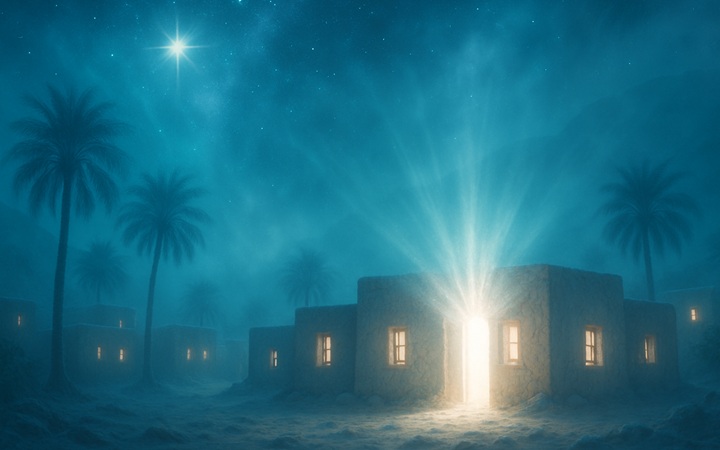
Ash−Shaffa, the mother of Abd Al Rahman, attended his birth and as Lady Amina gave birth her blessed baby was delivered prostrating upon his tiny hands and knees, then sneezed and said, “Al Hamdulillah” −− praise be to Allah −− whereupon a voice from the heavens replied, “May Allah have mercy upon you.”
As Ash−Shaffa looked out into the night sky the horizon became illuminated so that the very distant castles of Greece became clearly visible to her. Incidentally, “Al Hamdulillah” was the same praise Prophet Adam offered as he sneezed upon reaching earth.
The beautiful baby was born without a trace of dirt upon him, and a sweet aroma caressed his perfect little body. Lady Amina remembered the instruction she had been given in her vision and supplicated to Allah with it for her little son, then gave him to Ash−Shaffa, the mother of Abd Al Rahman to hold.
News that Lady Amina had given birth to a son was sent straight away to Abd Al Muttalib. As soon as he heard the good news he rushed to see his new grandson. When he reached the house his heart was filled with joy and tender loving care.
He cradled the sweet baby wrapped in a white cloth in his arms and then took him to the Ka’ba where he offered a prayer of thanksgiving to Allah for the safe delivery of his grandson. Before returning his new grandson to Lady Amina he went home to show him to his own family.
Standing at the door waiting for his father’s return was his three year old son Abbas. Lovingly, Abd Al Muttalib told his son, “Abbas, this is your brother, give him a kiss,” so Abbas, who was in reality his uncle, bent over and kissed his new baby brother.
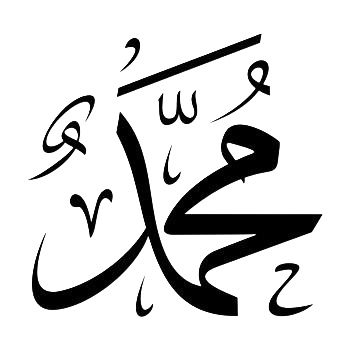
After everyone had admired the baby, Abd Al Muttalib returned to Lady Amina and in accordance with her vision and a vision Abd Al Muttalib had seen, the sweet baby was named Muhammad.
When people asked why they had named him Muhammad they replied, “To be praised in the heavens and earth.” Before that time the name Muhammad was unknown and no other child had ever been given that special name.
Abu Talib’s house, the house in which the Holy Prophet (sa) was born exists today and is used to house an Islamic library.
SPECIAL EVENTS DURING THIS BLESSED NIGHT
Ash−Shaffa was not the only person to witness miraculous events of this very special night. As Othman, the son of Abi As’s mother gazed up into the night sky she witnessed the stars lower themselves and a light so brilliant appeared at the time of his birth that she could see nothing except light.
In the kingdom of Chosroes, fortifications shook and balconies collapsed, whilst the waters of Lake Tiberias ebbed, and the famous flame of Persia, which had not been extinguished since it was lit a thousand years before, was suddenly quite unexplainably extinguished.
In the heavens, meteors were commanded to be on guard so as to prevent the satans from listening to the news the angels bore about the events of this very blessed night.
THE KNOWLEDGEABLE JEW
Amongst the citizens of Mecca were several Jews, one of whom was knowledgeable of the scriptures. He knew from his learning and the signs of the time that the birth of a new prophet was imminent and anxiously awaited his arrival.
On the night Prophet Muhammad, (sa) was born, a strange feeling came over him that prompted him to rush to the door of his house and ask some Koraysh tribesmen, who happened to be passing, if they had heard of any births that night.
The tribesmen replied that they knew of none, so he asked them to go and find out then bring word to him. He felt sure that this was the night in which the new prophet had been born, and if his feelings were correct he knew he would indeed be able to recognize him by a special, prominent mark on his skin that lay between his shoulders.
Sometime later, the tribesmen returned to the expectant Jew and told him that a son had indeed been born to Lady Amina, the widowed wife of Abdullah, son of Abd Al Muttalib. The Jew asked them to take him to see the newly born and his mother, so in haste they made their way to Abu Talib’s house.
When they arrived, Lady Amina presented her darling son to them and as the cloth that covered him was gently rolled back the Jew saw the unmistakable mark and fainted. When he regained consciousness he announced the prophethood had been taken away from the Children of Israel and said, “O people of Koraysh, by Allah, he will conquer you in a way that the news will traverse both east and west.”
The mark the Jew referred to was circular and read, “There is no god except Allah, and Muhammad is His Prophet”, and it was from this identifying mark that the sweet aroma of musk exuded.
THE DECISION OF LADY AMINA AND ABD AL MUTTALIB
Abdullah was a young man when he died and therefore had very little to leave his wife and unborn baby. All he was able to leave them was an Abyssinian maid named Barakah, which means blessing, a few camels and some goats. Barakah was also known by the name Umm Ayman.
During the first days of our beloved Prophet’s life, Barakah helped his mother to take care of him, and Thuwaybah, who attended his birth, became his first wet−nurse. In those days it was the practice of noble and well−to−do families to entrust their newly born infants to the care of good families living far from Mecca.
The infant would be less likely to contract the many diseases that all too often accompanied the pilgrims. Among the many advantages of sending a newly born to be raised in the desert was that it was there that Arabic in its purest form was spoken, and the accomplishment of speaking pure Arabic was a most sought after quality.
Youngsters also learned the essential art of survival through the mutual love and care for one another that in turn lead to excellent manners and a chivalrous nature. With this in mind Lady Amina and Abd Al Muttalib decided to send Muhammad to be raised in the desert.
HALIMA
Soon after his birth, several Bedouin families made their twice yearly journey to Mecca in search of a child to foster. No fee was requested by the foster parents as one might suppose, rather, the intent was to strengthen ties between noble, well−to−do families and perhaps receive a favor from its parents or relatives.
Amongst the prospective foster mothers was a lady called Halima, the daughter of Abdullah Al Sadiyyah from the tribe of Banu Hawazin. Halima’s family had always been poor, and that year in particular had been harsh for them on account of the drought that devastated the area.
Halima had a young baby of her own, so together with her husband, Abi Kabshah, and baby they traveled in the company of other families from their tribe to Mecca. Halima carried her son as she rode upon their donkey whilst her husband walked by her side and the sheep ran along beside them.
When they set out, the sheep’s milk had been a constant source of nourishment for them, but the strain of the journey took its toll and its milk dried up. Halima’s own milk was insufficient to satisfy her baby, and many a time her baby cried itself to sleep out of hunger.
Before reaching Mecca, there was another setback, Halima’s donkey started to show signs of lameness, so they proceeded slowly at their own pace whilst the others went on ahead. Because of the delay, Halima and her family were the last of the prospective foster parents to reach Mecca.
By the time she arrived each of the other prospective foster mothers had visited the homes of parents wishing to send their newly born to the safety of the desert, and chosen a baby. However, the planning of Allah was that all had declined the offer to take Lady Amina’s baby on account of him being an orphan, and so when Halima arrived he was the only one available.
As Halima entered Lady Amina’s house she found the tiny baby sleeping upon his back wrapped in a white woolen shawl under which a green piece of silk had been placed. Instantaneously, with just one glance, in the same way that the wife of Pharaoh’s heart had been filled with love for the baby Moses, Allah filled Halima’s heart with overflowing love.
Halima was overcome by his beauty, and as she bent down to pick him up she smelt the delicate fragrance of musk. Fearing she might disturb him, she placed her had over his chest and as she did he smiled, then opened his eyes and from his eyes beamed a radiant light.
Gently, and lovingly she kissed him between his eyes and offered him her right breast and immediately felt a surge of milk, he accepted her breast and suckled away contentedly. After a little while she offered him her left breast but even at this very tender age fairness was inherent in his nature and he declined leaving it for his new suckling brother.
Later on that day, Halima returned to her husband and told him that there was no doubt in her mind that she wanted to foster Lady Amina’s baby −− it was of no consequence to her that the baby was an orphan, or that future favors may not be possible −− the baby had completely captivated her heart.
THE BONDING
It is through the nourishing milk a foster mother gives to her charge that the baby gains an extended family into which marriage to its siblings is not permitted. And so it was that Halima’s foster child would refer to her in later years as his mother, and to her children as his brothers and sisters.
Right from the very beginning, the bonding between Halima and her foster child proved to be a very great blessing for not only her family but the entire tribe. And it was because of this very close relationship that her people were, in the years that followed, protected and led to Paradise.
THE PEACEFUL NIGHT
Whilst Halima was nursing Lady Amina’s baby, her husband, Abi Kabshah, went to tend his sheep and was very surprised to find its udder full of milk. When he milked it there was so much milk that there was more than enough to satisfy the entire family, that night they drank their fill and slept peacefully. When they awoke, Abi Kabshah exclaimed, “Halima, by Allah, I see you have chosen a blessed spirit, did you notice how we spent such a blessed night and are enjoying its benefits?”