THE MEMORABLE YEAR OF THE ELEPHANT
Fifty days before Muhammad was born, an event occurred which every person in Mecca would remember for the rest of their lives. It was an attempt by Abraha, the governor of Yemen, to destroy the Sacred Ka’ba with an elephant’s might.
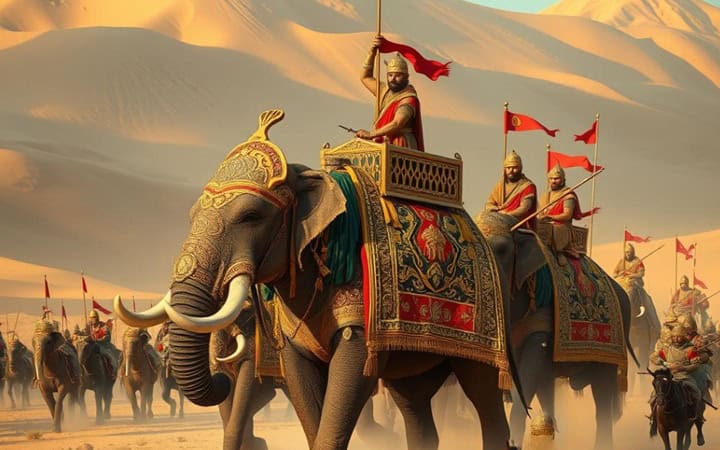
Abraha led a powerful army to destroy the Kaaba, supported by at least one elephant named Mahmūd, possibly accompanied by others. This event is famously remembered as the Year of the Elephant
Before that time the Arabs paid little attention to the passage of years, although each month was recognized by the new moon. From that year onwards the Arabs would refer to events as being either before the year of the elephant or after it.
At that time, Yemen was under the rule of Abyssinia. The King of Abyssinia, called the Negus, had appointed a governor named Abraha to govern Yemen in his absence. The Negus was a Nazarene who followed the true teachings of Prophet Jesus and not the trinitarian teachings of Paul, and Abraha, anxious to promote himself still further in the eyes of his king, decided he would build a magnificent church with the intent of luring pilgrims from Ka’ba to it.
The church was built in Sanna with marble pillaged from the ruined palaces of Sheba, whilst its interior was embellished with gold and silver, and its pulpit carved from ivory and ebony. Upon completion, Abraha sent word to the Negus that he had built a magnificent church in his honor and mentioned his underlying intention.
Abraha bragged so much of his intention to lure pilgrims away from the Ka’ba that word spread like the fury of a violent sandstorm throughout Arabia. As could be expected the Arabs were enraged by the whole affair to the extent that a man from the tribe of Kinanah, a branch of the Koraysh, was so incensed by the audacity of Abraha that he set out for Sanna determined to defile the church.
When he reached Sanna night had fallen so he crept unseen into the church and defiled it with trash and filth. Having accomplished his mission he left undetected. When news of the defilement reached Abraha his anger was so great that he swore to take revenge and to lead an army to would destroy Ka’ba once and for all.
Immediately, orders were issued to his army and they prepared themselves for the long march across the hot and sandy desert to Mecca. He also gave orders that an elephant should lead them as a sign of his might.
As soon as the preparations were complete Abraha gave the order to march with the canopied elephant leading the way. Not far out of Sanna the army encountered resistance from a small band of Arabs, but they were greatly out numbered and fled. Their leader, Nufayl, from the tribe of Khathan, was captured and in fear for his life offered to guide Abraha and his soldiers on to Ka’ba.
The news of Abraha’s march to destroy Ka’ba reached Ta’if ahead of their arrival, so a delegation from the Thakif, fearing Abraha might mistake their temple of Al Lat for Ka’ba, rode out to meet him and offered to be Nufayl’s co−guides, and Abraha accepted. At a place called Mughammis, a few miles outside Mecca, Abraha decided to strike camp and it was there that Nufayl died and was buried.
Meanwhile, Abraha sent his spies on in advance to the outskirts of Mecca. On their way they came across a herd of camels belonging to Abd Al Muttalib together with some other animals so they seized them together with anything else they could lay their hands on and sent their plunder back to Abraha.
In the meantime, Abd Al Muttalib, together with other Korayshi chieftains and chiefs from neighboring tribes met together to discuss how they might best defend their beloved Ka’ba. After much deliberation all concluded that Abraha’s army was so great in number that they did not stand a chance against him.
So Abd Al Muttalib decided it was best for the people of Mecca to seek refuge on the slopes of Mount Thabir saying, “O people of Koraysh, you will be protected,” and assured them that Ka’ba would be unharmed saying, “Abraha and his army will not reach the Holy Ka’ba because it has a Protecting Lord.”
As the people of Mecca made their way to the mountain, Abd Al Muttalib supplicated saying, “O Allah, it is customary for one to protect his possessions, so please, protect Yours.” Soon after, Abraha sent his envoy into Mecca inviting their leader to visit him in his camp and so Abd Al Muttalib, together with one of his sons accompanied Abraha’s envoy back to the camp.
As Abd Al Muttalib approached, Abraha was greatly impressed by his noble composure and rose to greet him. Abraha then told Abd Al Muttalib of his intent to destroy the Ka’ba and asked him if there was any favor he might grant him.
Abraha was extremely surprised by Abd Al Muttalib’s reply, he expected him to plead with him to spare Ka’ba but instead Abd Al Muttalib asked for the return of his herd of camels. Abraha scoffed at his request but the wise, trusting, Abd Al Muttalib replied, “I am the lord of my herd of camels, so I must protect them”.
“The Lord of Ka’ba will protect His House.” After this totally unexpected reply, Abd Al Muttalib and his son returned to Mecca. Soon after this Abraha gave the order to advance on Ka’ba and the soldiers took their marching positions behind the elephant.
Now that all was ready the elephants was given the command to rise and march, but they refused and sat still. Its handlers tried to tempt it, but when that failed they beat it, driving iron hooks deep into its flesh, but still the elephant refused to march on Ka’ba.
Then, one of its handlers had an idea to trick the poor elephant by turning it around to face the direction of Yemen, then, as soon as it started to walk to turn it around to march on Ka’ba. His deception worked for a while.
They succeeded to get the elephant to stand, and even take a few steps in the direction of Yemen, but when he tried to turn it around to march on Ka’ba, the elephant, with all its might, sat down and despite the renewed extreme cruelty it endured the elephant still refused to march on Ka’ba.

Suddenly, the sky became blackened with flocks of birds named “Ababil”. Each bird carried three stones, one in each claw and another in its beak. When the birds reached Abraha’s army they pelted the soldiers with them.
As soon as a soldier was struck by a stone he died −− not one single stone missed its mark. As for Abraha, he did not die instantly, the stones that hit him brought about a painfully slow death that caused his bones to crumble thereby bringing about the agonizing collapse of his ribs.
These miraculous affairs were witnessed by all the citizens present in Mecca that day, and as a result the year became known as the “Year of the Elephant.” As for the grave of Nufayl, the guide who had led Abraha to Ka’ba, the Koraysh took stoning it. Unfortunately, there are some misguided people who promote the theory that the stones carried by the birds were not in fact stones but rather microbes or germs.
Their knowledge of the Words of Allah is indeed pitiful, because their theory is in direct contradiction to the unchangeable word Allah, Himself, uses in the Koran to describe the event. The word Allah uses is “Hijaratin” which means “stones” −− and the knowledge of Allah is the truth. Allah sent down the following chapter confirming the event:
In the Name of Allah, the Merciful, the Most Merciful. Have you not seen how Allah dealt with the companions of the Elephant? Did He not cause their schemes to go astray? And He sent against them flights of birds pelting them with stones of baked clay, so that He made them like straw eaten (by cattle). Quran: 105 (Al-Fil), The Elephant